
📺 Eyes on the Screen: The WSL’s Visibility Paradox in 2025-26
Coverage rose 76%, but reach fell 10%. Sky delivered more football, the BBC delivered the biggest audiences, and Instagram powered the WSL’s largest digital season yet.

Introduction
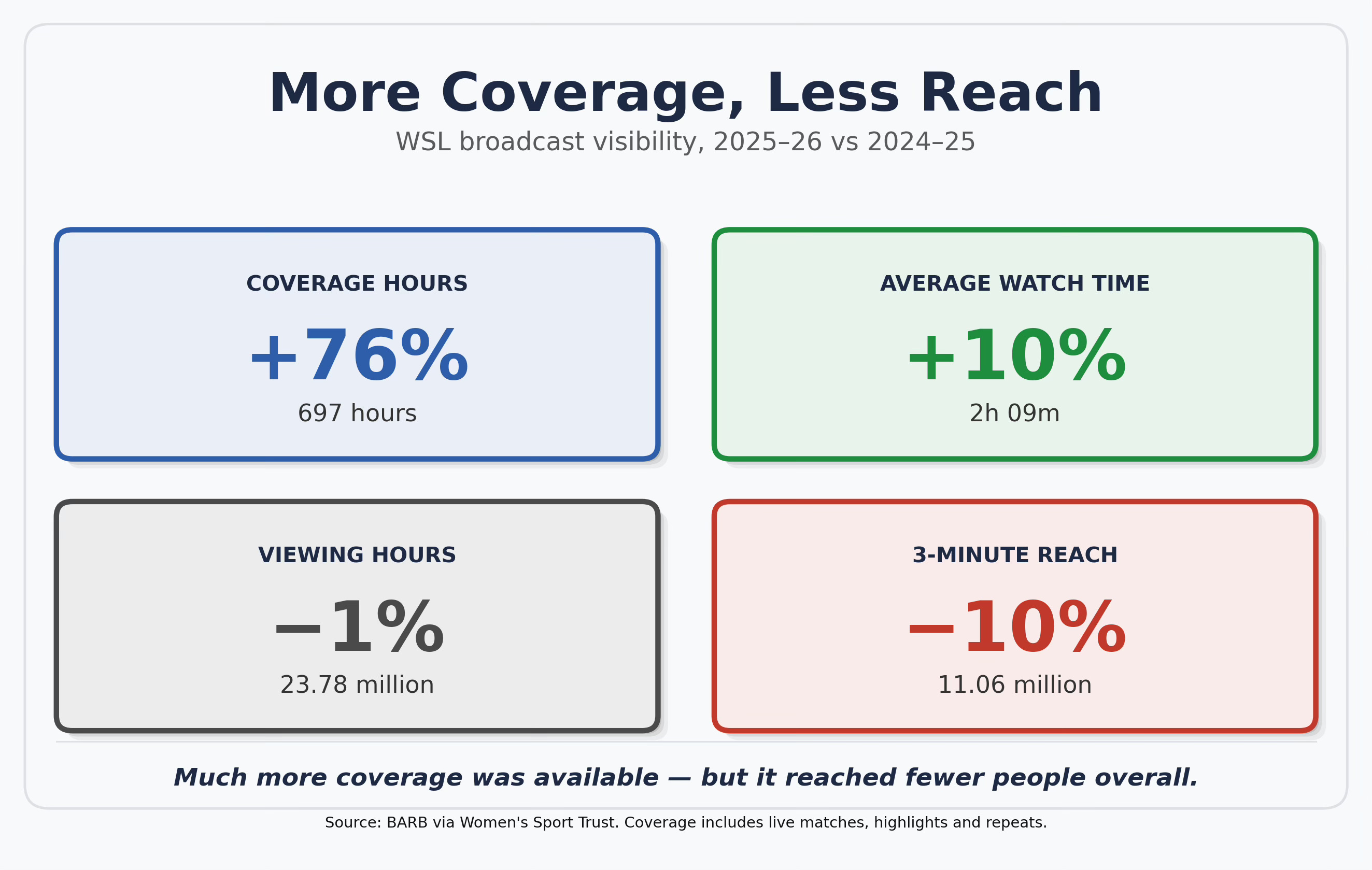
The 2025–26 Barclays Women’s Super League exposed a new visibility paradox. Total dedicated coverage rose 76% to 697 hours; however, three-minute reach (the number of unique viewers who watched at least three consecutive minutes) fell 10% to 11.06 million. More WSL football was available than ever, but fewer people saw it, with fewer fixtures on BBC, more scheduling clashes and new early broadcast slots fragmenting the audience.
This is not a simple collapse in interest. Those who watched stayed longer, with average watch time rising 10% to a record two hours and nine minutes, while viewing hours remained broadly flat. Beyond television, the league generated a record 669 million social video views, although the main growth engine shifted decisively from YouTube to Instagram.
Bottom Line Up Front: The WSL secured more coverage and deeper engagement, but not greater reach. Its next challenge is turning wider availability into genuine audience growth.
More Games, Fewer Eyes 📉
Reach down, engagement up
The headline WSL broadcast figures tell a split story. Coverage expanded dramatically, but audience growth did not follow:
Three-minute reach: 11.06 million, down 10%
Viewing hours: 23.78 million, down 1%
Average watch time: 2:08:58, up 10%
Coverage hours: 697, up 76%
Taken together, the figures point to a smaller but stickier audience. Fewer people encountered WSL coverage, but those who did stayed for longer. With coverage rising 76% while total viewing hours remained broadly flat, the additional programming appears to have deepened consumption among existing fans rather than attracted large numbers of new viewers.
Sky Built Habit, BBC Built Reach
The broadcaster split explains why more WSL coverage did not translate into greater overall reach. The BBC reduced its output, while Sky dramatically expanded its schedule, but the two platforms served very different audience functions.
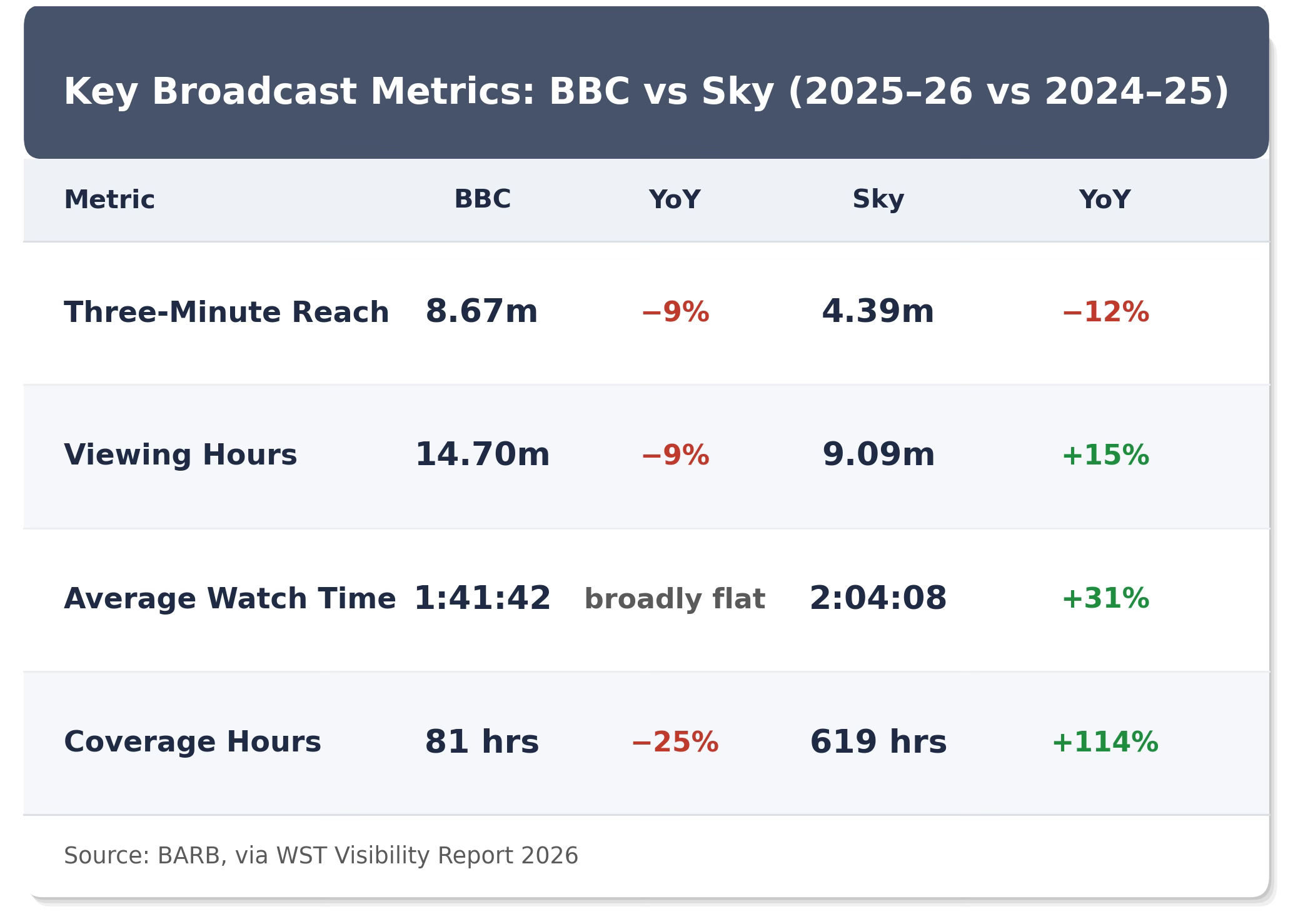
Sky more than doubled its live linear output, from 35 matches to 72. That additional volume increased viewing hours and substantially deepened average watch time, even though the number of people reached declined. Sky became the platform where committed viewers watched more WSL, more often.
The BBC moved in the opposite direction. Its reach and viewing hours both fell as coverage declined, with only 13 matches shown on BBC One or BBC Two, down from 15 the previous season. The clearest interpretation is that Sky built viewing habit, while the BBC remained the league’s gateway to mass reach.
Sky delivered more WSL. The BBC still delivered broader visibility.
The Noon-Slot Reset ⏰
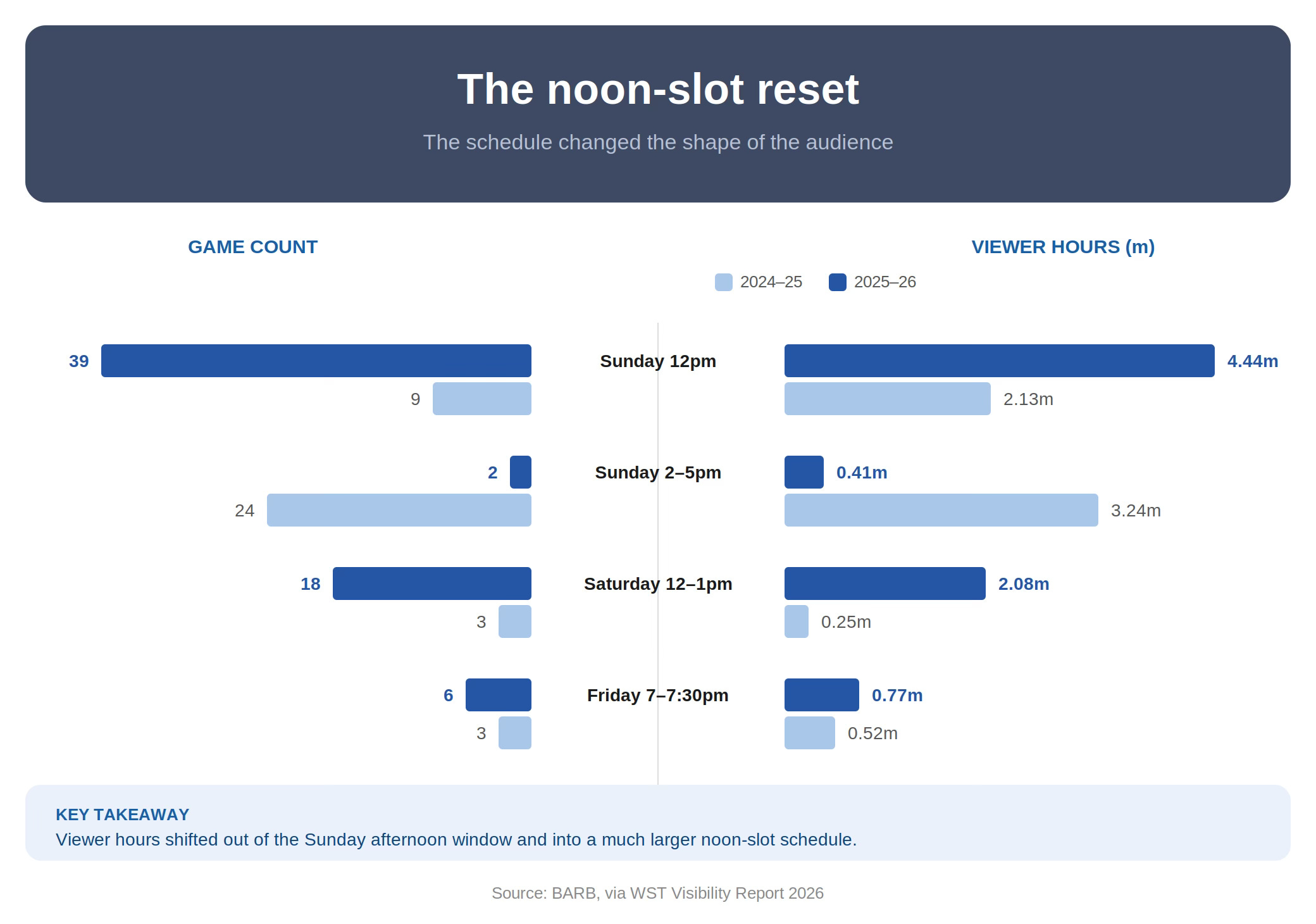
The biggest scheduling change of 2025–26 was the expansion of the Sunday noon slot. Sky placed far more matches into earlier windows, while the traditional Sunday afternoon block became far less central. Viewer hours followed that shift: noon and Saturday lunchtime gained importance, while the old 2–5pm Sunday window lost ground. The result was not just a different schedule, but a different audience pattern, one spread across more windows and fewer shared viewing moments.
The likely driver was avoiding direct clashes with the Premier League’s Sunday afternoon broadcasts. But in practice, it weakened one of the league’s most valuable assets. Mid-afternoon slots typically draw larger casual audiences than noon kick-offs, when people are still finishing weekend routines. The shift also created a clash with WSL 2 match-goers, who have a strong overlap with the WSL audience. Moving fixtures to earlier windows filled Sky's schedule, but at the cost of the most important viewing window the league had last season.
The Loyal Core Got Stickier 🔁
Fewer viewers, stronger viewing habits
Even as overall reach declined, the viewers who did tune in came back more often. Looking at how many separate occasions each viewer watched WSL coverage compared to last season:
2+ occasions: 44%, unchanged
3+ occasions: up from 25% to 26%
4+ occasions: up from 18% to 19%
5+ occasions: up from 13% to 14%
10+ occasions: up from 4% to 6%
Combined with average watch time reaching a record two hours and nine minutes, the pattern is clear: fewer people encountered WSL coverage, but the regular audience watched for longer and returned more often.
The strategic challenge is therefore not retaining the committed core. It is converting casual viewers into regular ones when more fixtures sit behind a paywall or within unfamiliar broadcast windows.
The WSL’s core audience is deepening. Its next growth opportunity lies outside that core.
The BBC Still Owns the Big Moments 🏆
Free-to-air remains the WSL’s biggest stage
Every one of the ten largest live WSL audiences in 2025–26 came on BBC. Not one Sky-only broadcast made the list.
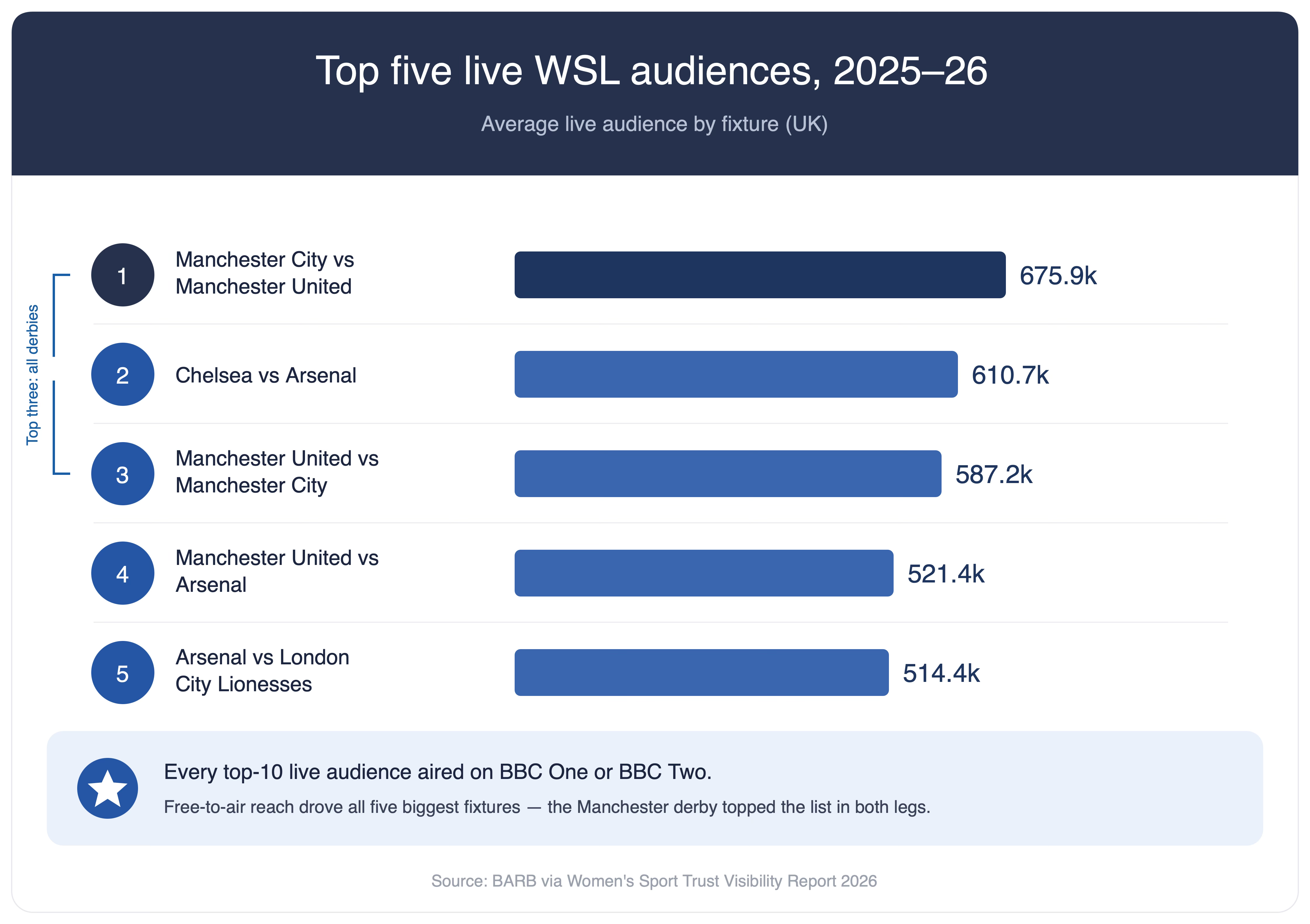
The pattern is difficult to ignore. Sky supplied the volume, but the BBC continued to deliver the league’s largest shared audiences. The Manchester clubs were especially prominent, appearing in three of the top four fixtures.
There is still a warning sign. The season’s peak audience of 675.9k was below the 732k recorded for Arsenal vs Chelsea last season and the 813k Manchester derby peak from two seasons ago. The BBC remains indispensable, but the ceiling for marquee WSL broadcasts has continued to soften. Is that ceiling now structural, or can the right fixture still break through?
Sky delivered frequency. The BBC still delivered the occasion.
The 2025–26 Digital Story
Record scale, but a very different engine
Away from the linear screen, 2025–26 was the biggest digital season in the WSL’s history. Combined video views across the league’s owned accounts reached 669 million, up 85% year on year, comfortably above the previous high of 553 million in 2022–23 and nearly double last season’s 363 million.
But the composition of that record changed completely. Last season, the story was YouTube. This season, it is Instagram, which alone accounted for 371 million of the 669 million total.
Instagram: 65m to 371m
TikTok: 115m to 162m
Facebook: 139m to 113m
YouTube: 44m to 23m
On the reported figures, Instagram contributed all of the WSL’s net year-on-year growth. TikTok also grew strongly, but those gains were offset by declines on Facebook and YouTube. This was not broad-based growth across every platform. It was a record digital season powered overwhelmingly by one channel.
It is worth noting that Meta’s change to how it counts video views (moving from 3-second to 1-second views) inflates this number. However, even accounting for that, the shift in audience behavior toward Instagram is undeniable.
Instagram alone accounted for more views in 2025–26 than all other WSL digital platforms combined. That concentration represents a significant opportunity for the league, but also a vulnerability if Instagram’s algorithm shifts or its engagement model changes.
The WSL reached record digital scale in 2025–26, but almost all of that growth came through Instagram.
YouTube: The Correction
YouTube is the one platform that moved decisively backwards. Total WSL views fell 48% to 23 million, dropping the league from second place last season to sixth. Views per video declined 35%, from 77k to 50k, while uploads fell 19%. Yet the WSL still ranked third globally for YouTube views per video, suggesting that the content itself continued to perform relatively well when audiences encountered it.
The deeper explanation lies in the loss of live football. Last season, YouTube was not merely a social-content platform; it was one of the league’s principal broadcasters. Seventy of the WSL’s 132 fixtures, more than half of the season, were streamed free on the Barclays WSL YouTube channel, giving supporters one clear destination for live matches every weekend. Those full-game streams generated long viewing sessions, repeat traffic and a powerful first-season novelty effect.
Under the new rights cycle, live coverage shifted decisively towards Sky and the BBC, leaving YouTube with a much smaller live-match role than in 2024–25. With fewer full matches, and the remaining free coverage spread across different channels, the weekly viewing habit built the previous season weakened.
The fall should be read as a distribution correction, not simply a collapse in interest. YouTube lost the live-match engine that had driven much of its previous growth.
YouTube did not lose momentum; it lost the product that created that momentum.
What the Season Really Tells Us
The 2025–26 WSL season was not a simple story of growth or decline. Coverage expanded dramatically, but reach fell. Sky deepened viewing among committed fans, while the BBC continued to deliver the league’s biggest shared audiences. Online, the WSL reached record scale, but that growth was concentrated in Instagram as YouTube lost the live-match role that had powered its breakout season.
The central challenge is now clear: the WSL does not lack content or committed supporters. It needs to turn wider availability into discovery, convert casual viewers into regular ones, and ensure that fragmentation across broadcasters, timeslots and platforms does not weaken the moments that create mass attention.
That raises a question the next rights cycle will have to answer. The BBC’s reach is falling as its fixtures decline, but it still delivered every one of the season’s ten largest audiences. Sky built habit, but habit alone does not grow a league. Can the WSL afford to keep losing its biggest shop window, or is the future simply a smaller, more committed audience behind a paywall?
The WSL has built depth. Whether it can rebuild breadth without free-to-air prominence is the question that will define the next chapter.
This analysis is based on BARB linear-TV ratings, YouTube viewing data (via Tubular Labs), verified social-media metrics (Tubular Labs + Meta Content Library) as compiled in the Women’s Sport Trust 'The Battle for Attention’ Visibility Report (July 2026).
👋 Stay Connected
If you want weekly WSL insights, stat deep-dives and match previews, subscribe and share – and we’d love to hear your take, so reply or comment below 💬
Follow @WSLAnalytics on X for bite-sized stats and updates.
Really interesting article!
I really struggled with the changes in kick off times this season! I left this feedback on the WSL end of season survey, so I hope that other people did too!
Thanks for sharing this piece - I’d be interested to hear your thoughts on a piece I have coming up in a couple of weeks time on the competitive gap in the WSL between the big 3 and the rest of the league!