
WSL 2025–26 Mid-Season Review: Title Race and Top Five (Part 1)
From City’s tactical revolution to Chelsea’s 47% scoring collapse, we analyse the top five teams’ contrasting approaches – and what the data says about their title credentials.


Introduction
As the 2025–26 Barclays Women’s Super League (WSL) hits its halfway mark, the league has showcased fierce competitiveness and drama. Defending champions Chelsea saw their record 34-match unbeaten streak finally snapped, while a resurgent Manchester City have stormed to the top of the table.
Only 10 points separate the top five teams – a tighter pack than in recent years. Meanwhile, a fierce battle rages at the bottom, where the threat of a relegation playoff looms. (The WSL expands to 14 teams next season, meaning the bottom-placed side will face the survival playoff instead of straight relegation.)
The first half has been defined by clear tiers of teams, evolving tactical identities, and some surprise success stories.
Scoring has remained consistent – 194 goals in 66 matches (2.94 per game) – virtually identical to last season’s 2.91 goals per game at the halfway mark. Beneath this stability, though, lies a fascinating paradox: teams are creating better chances (expected goals up from 2.74 to 2.91 per game), but conversion rates have declined. This 0.17 xG increase should have produced a modest goal increase, but instead reveals how finishing quality has become increasingly polarised – some teams converting chances clinically while others squander golden opportunities.
In this mid-season review series, we’ll break down the title race and top-five picture, explore key league-wide trends, categorise teams into tiers, and identify players and tactical themes to watch in the second half. The goal: an accessible yet data-driven snapshot of where the WSL stands at the halfway mark.
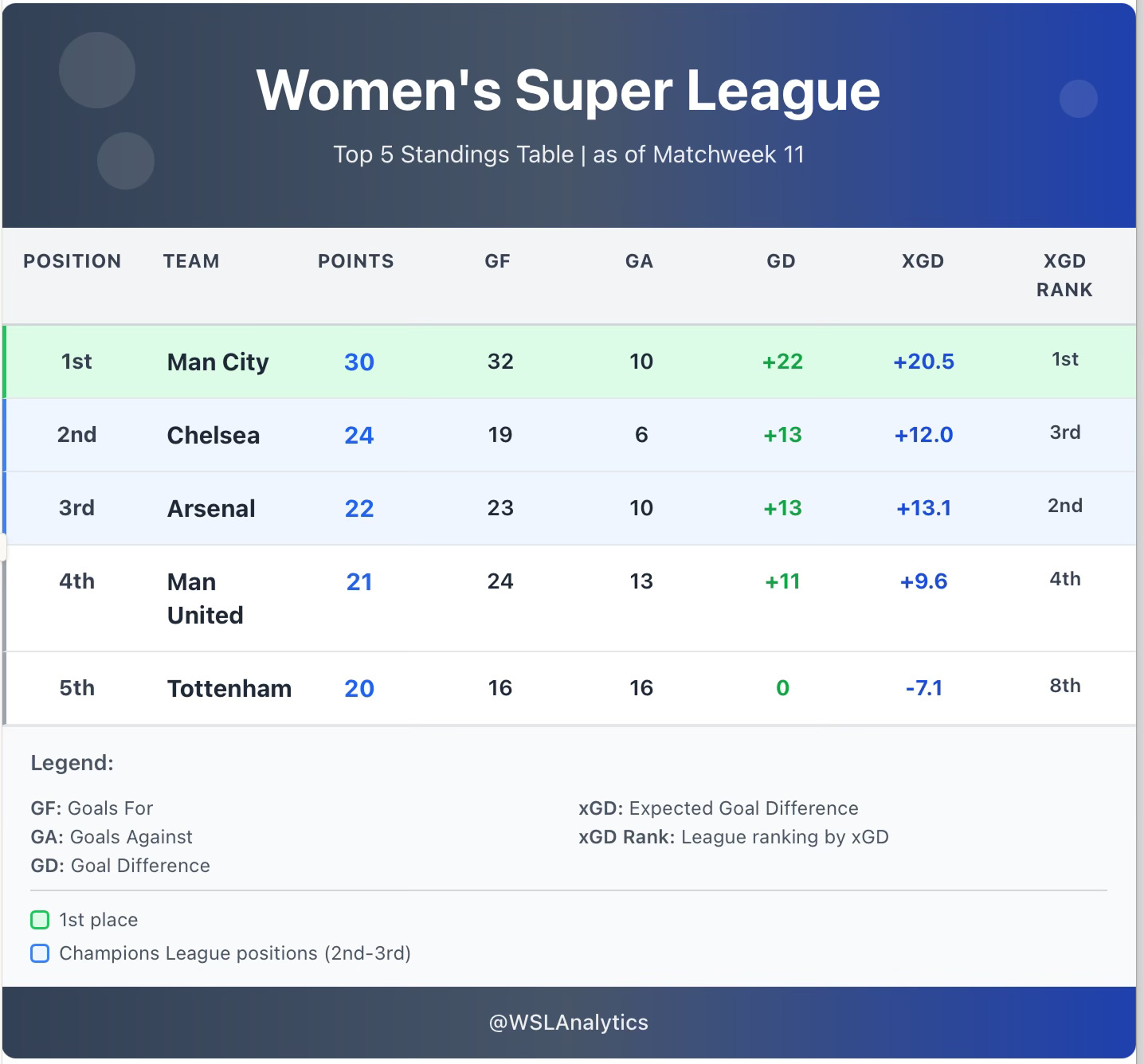
Here’s the top-five snapshot at the halfway mark (points, goal difference, and xGD). City lead both on points and on xGD, while Spurs are the early outlier – results ahead of process.
Title Race and Top Five: Process vs. Results
Manchester City: The Tactical Revolution
Manchester City have emerged as the league’s clear front-runners, topping the table with 30 points from 11 matches and riding a 10-game winning streak after their opening-day loss to Chelsea. But the story isn’t just the results – it’s how they’re getting them. New head coach Andrée Jeglertz has fundamentally reimagined City’s approach, and the transformation has been stunning.
The tactical revolution is unprecedented: City have dropped from 70.6% possession last season to 55.8% this year, a massive 14.8 percentage point decline. They’re making 199 fewer passes per game (617 to 417) and 118 fewer passes in the opposition half. This isn’t gradual evolution – it’s a complete philosophical overhaul from Gareth Taylor’s possession-heavy legacy to a more direct, transition-focused style.
City lead the league in scoring with 32 goals – up from 23 at this stage last year – and boast a +22 goal difference. Khadija Shaw has been the catalyst with 12 goals – nearly triple the tally of any other player in the league. But it’s not just Shaw: the system has unlocked Vivianne Miedema (4 goals, 3 assists), while Aoba Fujino has contributed 4 goals and Kerstin Casparij provides 4 assists from wing-back.
City’s dominance is backed by underlying metrics: their expected goal difference of +20.5 leads the league by a significant margin, indicating sustainable performance. With an actual goal difference of +22 (just 1.5 goals above expectation), they’re not overperforming – they’re simply executing at an elite level. They’ve proven they can win decisively without possession dominance – a tactical flexibility that makes them formidable title favourites.
Chelsea: Scoring Crisis
Behind City sits a pack of title contenders, but none face a more pressing concern than defending champions Chelsea. Sitting 2nd with 24 points, the Blues have suffered a dramatic scoring collapse: they’ve plummeted from 3.27 goals per game at this stage last season to just 1.73 – a staggering 47% decline.
The numbers reveal a dual crisis. Chelsea are creating fewer quality chances – their expected goals have dropped to 2.08 per game while taking 2.5 fewer shots per match. Worse still, they’re underperforming even these diminished expectations, scoring just 1.73 goals per game against an xG of 2.08. This combination has cost them seven points compared to this stage last year—a collapse that’s particularly shocking given how they started.
Last season, Sonia Bompastor picked up where Emma Hayes left off, extending their unbeaten run in the WSL to a record 34 games. This season, however, shocking stumbles have derailed their campaign. A 1-1 draw at then-bottom Liverpool hinted at trouble, before a shock defeat to Everton ended their historic streak. These results have left them 6 points behind City. Defensively they remain elite (only 6 goals conceded), but their attack has become sterile—and the personnel struggles explain why.
Young talents like Agnes Beever-Jones have contributed (4 goals), but no one has stepped up to lead the line consistently. With both chance creation and conversion down significantly, Chelsea face a double-edged problem that threatens their bid for a seventh consecutive title. The six-point gap may still be bridgeable, but only if they rediscover their attacking identity quickly.
Arsenal: Process Over Results
Arsenal (3rd, 22 points) present a fascinating paradox. Their underlying numbers are elite – an expected goal difference of +13.1 ranks second in the league behind only Manchester City, and they’re overperforming even those strong metrics (23 goals from 21.7 xG). Yet they sit two points behind last season’s pace despite creating similar quality chances.
Arsenal’s creative numbers are impressive. Beth Mead leads with 4 assists, while Mariona Caldentey has created 28 chances. Goals are distributed well – Stina Blackstenius and Alessia Russo have 5 each – providing multiple attacking threats. Defensively, they’re solid with just 10 goals conceded. Yet these impressive metrics haven’t translated into the points their performances deserve.
They’ve dropped points in four draws, matches where they controlled possession and created chances but couldn’t find the clinical edge to close games out. This pattern has cost them valuable ground on City and Chelsea.
The gap between performance and results suggests Arsenal are closer to a breakthrough than their position indicates. Their chance creation is elite, their defensive structure solid, and their squad depth impressive. If they can convert control into consistent wins in the second half, they remain genuine title contenders.
Manchester United: The Possession Paradox
Manchester United (4th, 21 points) embody this season’s “process vs results” theme more than any other team. They’ve undergone their own tactical revolution – but in the opposite direction to City. United have transformed from a counter-attacking side (45.9% possession last season) to a possession-heavy team (58.5% this year), representing a massive 12.6 percentage point increase.
The numbers are remarkable: United now make 167 more passes per game (284 to 451) and 98 more passes in the opposition half. They’ve improved their attack (24 goals vs 20 last year), with Ella Toone emerging as a creative force (5 assists, 15 chances created). Goals are well distributed: Melvine Malard has 5, Jess Park 4, and Elizabeth Terland 3 – all contributing to a more balanced attack.
But here’s the paradox: despite better attacking numbers and a solid expected goal difference of +9.6, United have 3 fewer points than last season. The culprit? A defensive collapse that has seen them concede nearly double last season’s total – 13 goals compared to just 7 at this stage last year.
A wild 3-3 draw against Spurs illustrated both problems perfectly. United outshot Tottenham 34-5, racked up nearly 5.0 xG to 0.8, yet had to storm back from 3-0 down to salvage a draw. They hit the woodwork four times and converted only 3 of 9 big chances—but also conceded three goals from minimal opposition threat, highlighting their new defensive fragility.
This encapsulates United’s season: attacking improvement undermined by defensive frailty. If they can shore up a backline that’s being exploited on the counter while finding their clinical edge in front of goal, they have the ingredients for a strong finish. But unless they solve both problems, their possession revolution threatens to keep them outside the Champions League places.
Tottenham: The Defensive Masterclass
The most remarkable transformation belongs to Tottenham Hotspur (5th, 20 points), who’ve executed a complete identity shift under new manager Martin Ho. Spurs have pivoted from an attacking, chaotic side to a pragmatic, defense-first approach – and it’s paying off handsomely.
The defensive revolution is stark: Tottenham have slashed their goals conceded from 23 at this point last season to just 16 this year – a 30% reduction. They’ve maintained the exact same attacking output (16 goals both seasons) while dramatically tightening at the back, resulting in a 6-point improvement that has them just one point behind United. Remarkably, they’ve already matched their entire 2024-25 season point total with 11 games still to play.
Spurs’ approach represents tactical discipline over flair. They take fewer shots (down from 12.2 to 9.9 per game) and create fewer big chances, preferring structure over adventure. Their expected goal difference remains negative (-7.1), yet they’ve turned underlying struggles into tangible results through defensive organisation and clinical finishing in key moments.
The Spurs-United comparison is instructive: where United’s possession revolution has left them defensively exposed, Tottenham’s pragmatic approach has brought stability. Their 3-3 draw at United – where they scored 3 goals from just 5 shots while United needed 34 attempts – perfectly exemplified their efficiency-over-volume philosophy.
If Spurs can maintain this defensive discipline in the second half, they’re on course for their best-ever WSL point haul. Their transformation proves that tactical identity and defensive solidity can trump possession statistics and attacking flair.
The Verdict: Different Paths, Uncertain Destinations
Manchester City sit 6 points clear at the summit, but the battle for the remaining two Champions League spots remains wide open. Chelsea, Arsenal, United, and Tottenham are separated by just 4 points, with fundamentally different tactical identities competing for those coveted spots.
The data reveals divergent paths to success: City’s transition-focused revolution is backed by elite metrics. Chelsea’s defensive solidity can’t compensate for their attacking drought. Arsenal’s strong underlying numbers deserve better results. United’s possession dominance has come at a defensive cost. And Tottenham are succeeding despite poor expected goal numbers through sheer pragmatism.
The second half will test whether process trumps results: will regression to the mean catch up with Tottenham’s overperformance while rewarding Arsenal and United’s superior metrics? Or can clinical finishing and defensive grit continue to defy the data? One thing is clear – there’s no single blueprint for success in this season’s WSL, and that unpredictability makes the race compelling.
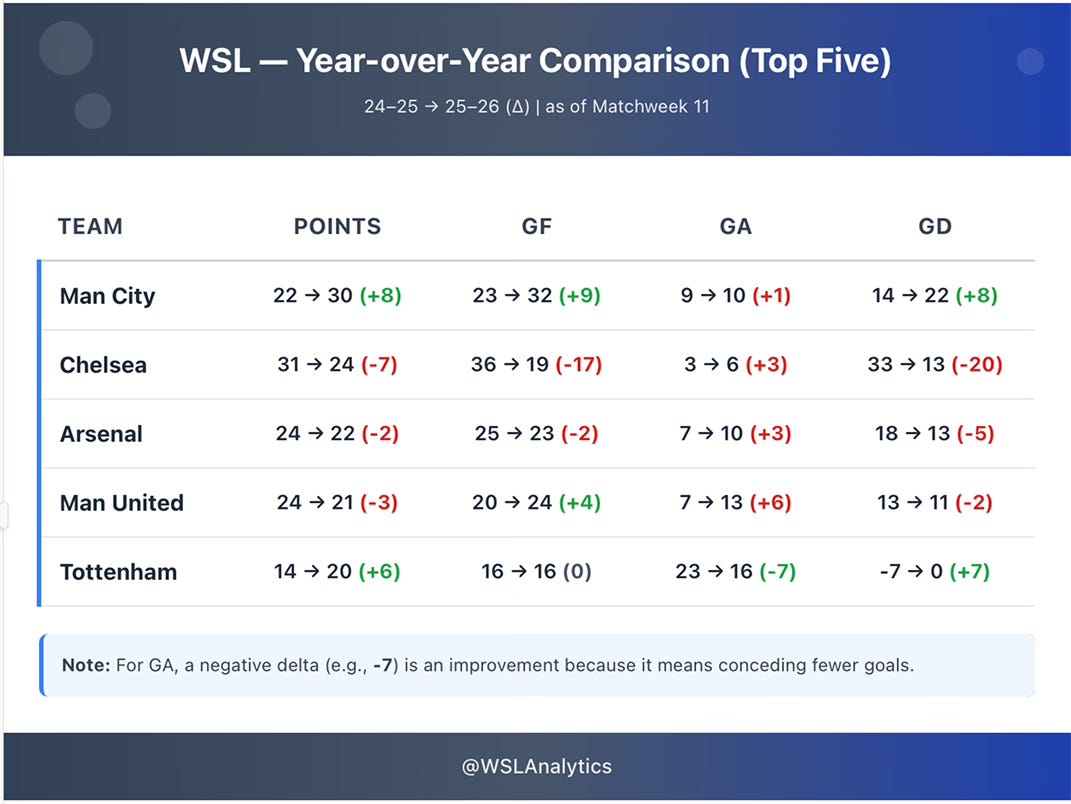
Year-over-year comparison reveals dramatic swings: Chelsea’s 17-goal collapse, City’s 9-goal improvement, and Tottenham’s defensive transformation (-7 goals conceded).
Data & methodology
All figures are WSL league matches only, through Matchweek 11 (11 matches per team; 66 matches total). Team and player statistics are compiled primarily from FotMob, with club match reports used to verify specific match details where needed.
Coming next: In Parts 2, we'll examine the rest of the league table (teams 6-12), explore league-wide tactical trends, and present key storylines and data-driven predictions for the second half.