
What Alexia Putellas can change at London City Lionesses
A data-led look at one of the biggest transfers in Women's Super League history—and what it could mean for London City's next chapter.


1. Introduction
London City Lionesses are only seven years old. Alexia Putellas has spent almost twice that long in Barcelona’s first team.
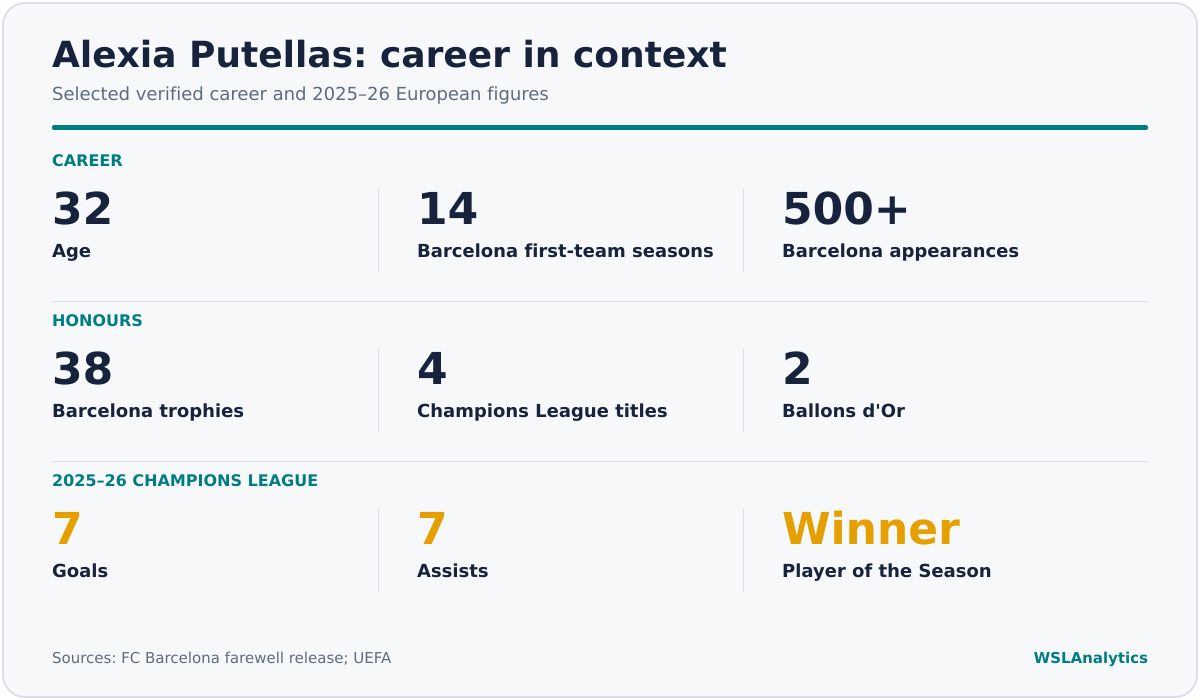
That contrast is the starting point for understanding this transfer. One side is still defining what it wants to become at the highest level of English football. The other is a player whose career has already helped define an era: more than 500 Barcelona appearances, four European Cups, two Ballons d’Or and a place at the centre of Spain’s rise to world champions.
This move is more interesting as a football decision than as a meeting of a young club and a famous name. London City finished sixth in their first WSL season. They were competitive, ambitious and capable of troubling stronger opponents, but they were not consistent in possession or chance creation. Putellas arrives with the specific qualities to improve how those parts connect.
Whether that connection works will tell us much more about London City’s project than the announcement itself.
2. The transfer
London City officially confirmed Putellas on 8 July 2026 and gave her the No. 11 shirt. She joins after leaving Barcelona at the end of a 14-season first-team career, with her previous contract having expired. The deal is reported to run until 2029.
What London City have unquestionably acquired is a left-footed creative midfielder who can play centrally, from the left or, when required, as a false nine. They have also acquired a captain, a proven scorer from midfield and a player who was named the 2025–26 UEFA Women’s Champions League Player of the Season.
3. Why this matters
Putellas did not merely collect trophies at Barcelona. She was present as the team developed from a domestic power into one of Europe’s defining sides, becoming their regular captain and club-record women’s scorer along the way. She left Barcelona with 38 trophies, including four Champions Leagues and ten league titles.
She becomes the first Ballon d’Or Féminin winner to play in the WSL. That gives the move a clear place in the competition’s history and makes her arguably one of the highest-profile arrivals the league has seen, without considering transfer fees.
The destination is what makes the move unusual. Putellas has not left one established European superpower for another. London City are entering only their second WSL campaign and did not qualify for Europe. They are the competition’s first fully independent club, without the institutional shelter of a men’s football operation, and their football identity is still under construction.
For London City, the signing compresses years of reputation-building into a single moment. A player of Putellas’s standing choosing the club gives their ambition credibility. But credibility is not the same as achievement. The more important test is whether the organisation can build a side in which her qualities remain decisive.
4. What problem is London City trying to solve?
London City’s first WSL season was successful in the basic sense that a promoted team established itself in mid-table. They finished sixth with 27 points from 22 matches, scoring 28 goals and conceding 35. Eight wins demonstrated that they belonged at the level, while the 22-point gap to third place showed how far they remained from Champions League qualification.
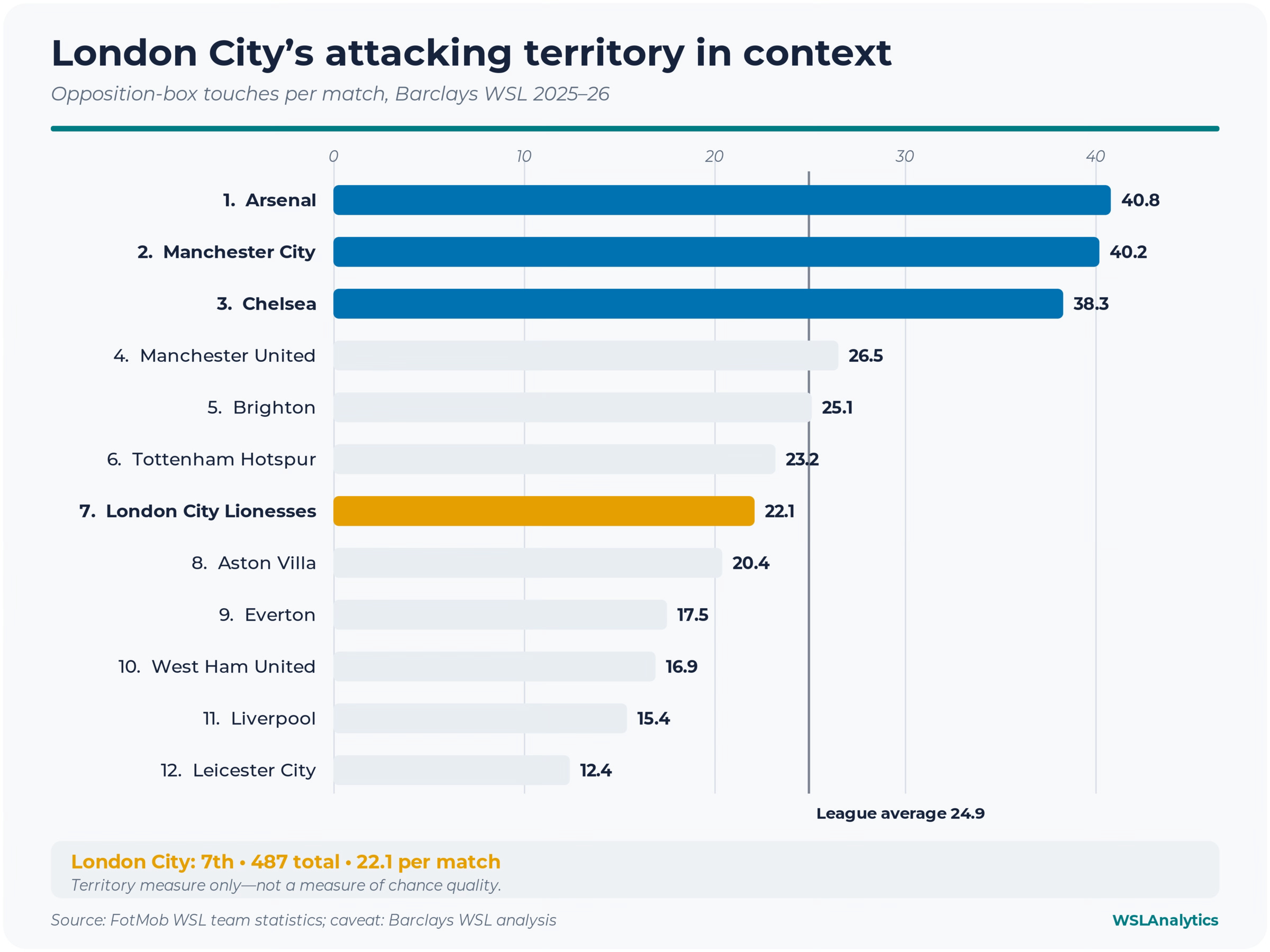
Their football under Eder Maestre contained promising ideas but not yet a settled expression. They used 4-2-3-1 and 4-4-2 structures and often looked to combine possession with vertical attacks and assertive pressing. Across the full season, they recorded 487 touches in the opposition box, the seventh-highest total in the WSL, equivalent to just over 22 per match. That placed them comfortably above the league’s lowest-volume attacks, but still well behind Arsenal, Manchester City and Chelsea, who averaged almost 40 opposition-box touches per match between them.
These observations should not be treated as permanent traits. Maestre arrived only in January, inheriting a heavily rebuilt squad during its first top-flight campaign.
London City need a player who can connect controlled possession to the final action. They need someone comfortable receiving between lines, deciding whether to retain or accelerate the ball, and supplying runners before the defence is set. Putellas can do all of those things. She also gives them another goal threat arriving from behind the forward line.
She does not solve the entire attacking problem herself. Creativity depends on the movement around the ball, while a secure attack depends on the structure left behind it. But the recruitment logic is clear: London City are adding an elite central reference to a team that too often struggled to turn territorial ambition into consistent chances. The next question is whether Putellas still has the workload and production to provide that influence consistently.
5. Alexia’s football journey
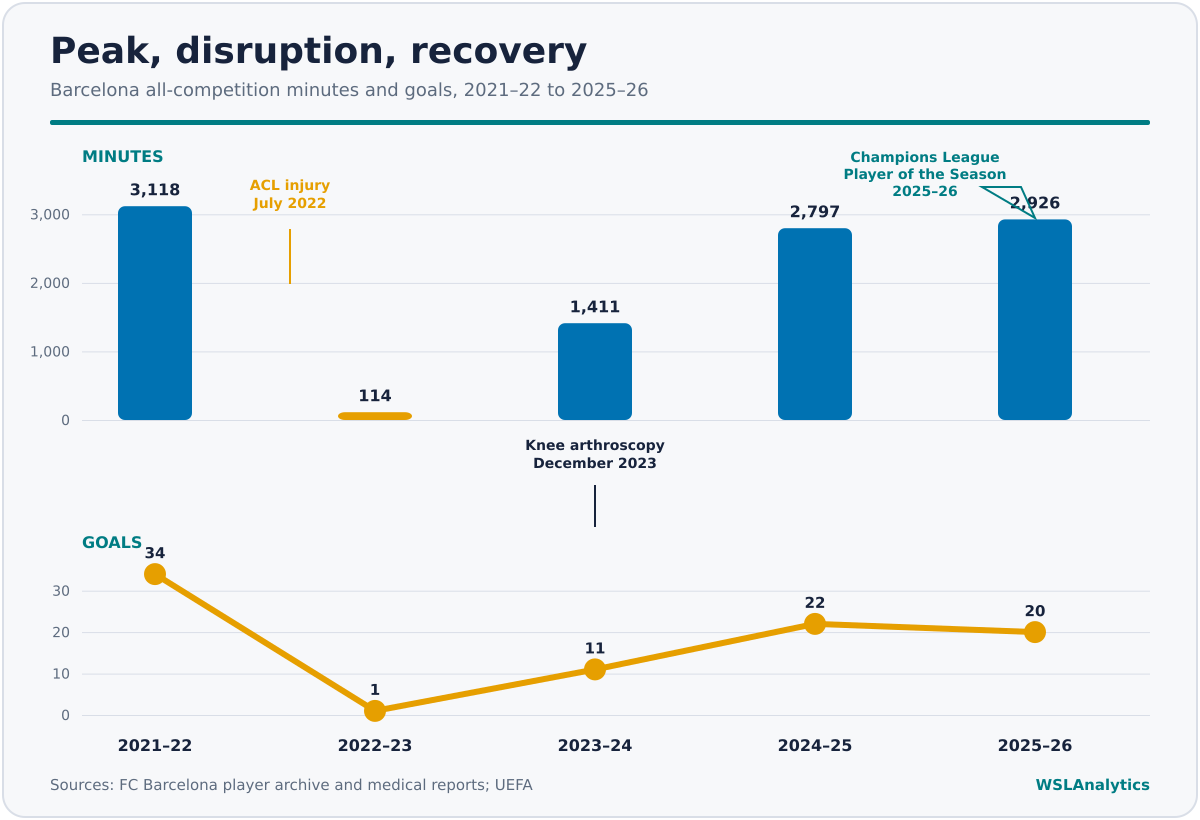
Putellas’s recent career cannot be described by a simple age curve. Her peak 2021–22 season brought 34 goals in all competitions and a second consecutive Ballon d’Or. Then, on the eve of the 2022 European Championship, she tore the anterior cruciate ligament in her left knee.
The effect on her playing time was stark. She went from 3,118 minutes in all competitions in 2021–22 to 114 the following season. Her return continued in 2023–24, although she underwent arthroscopy on her left knee in December 2023. That season ended with 1,411 minutes and 11 goals in all competitions: meaningful production, but not yet her old workload.
The next two campaigns changed the picture. Putellas played 2,797 minutes and scored 22 times in 2024–25, then reached 2,926 minutes and 20 goals in 2025–26. Her domestic league return eased from 16 goals and 11 assists to nine and seven, but her European contribution moved in the other direction. She recorded seven goals and seven assists in 11 Champions League appearances and was named the competition’s player of the season.
This contrast is important. It prevents an easy claim that she is either back to her absolute peak or in straightforward decline. Her 2021–22 scoring season remains unmatched, and age broadens the uncertainty around future workload. At the same time, her latest European performances were those of an elite footballer influencing the highest level.
This is therefore not a retirement move as many might claim. Putellas leaves Barcelona after a season in which she played almost 3,000 minutes, won another Champions League and led the competition for combined goals and assists. London City are signing a historic player, but they are not signing history alone.
6. What can previous WSL transfers tell us?
Transfer projection is difficult because a player’s first season depends on more than their previous output. Timing, injuries, tactical role, squad competition, destination-club strength and the number of available league matches can all affect the outcome. Two apparently similar arrivals may therefore receive very different opportunities. To provide some context, we looked at recent players who moved from Liga F to the WSL.
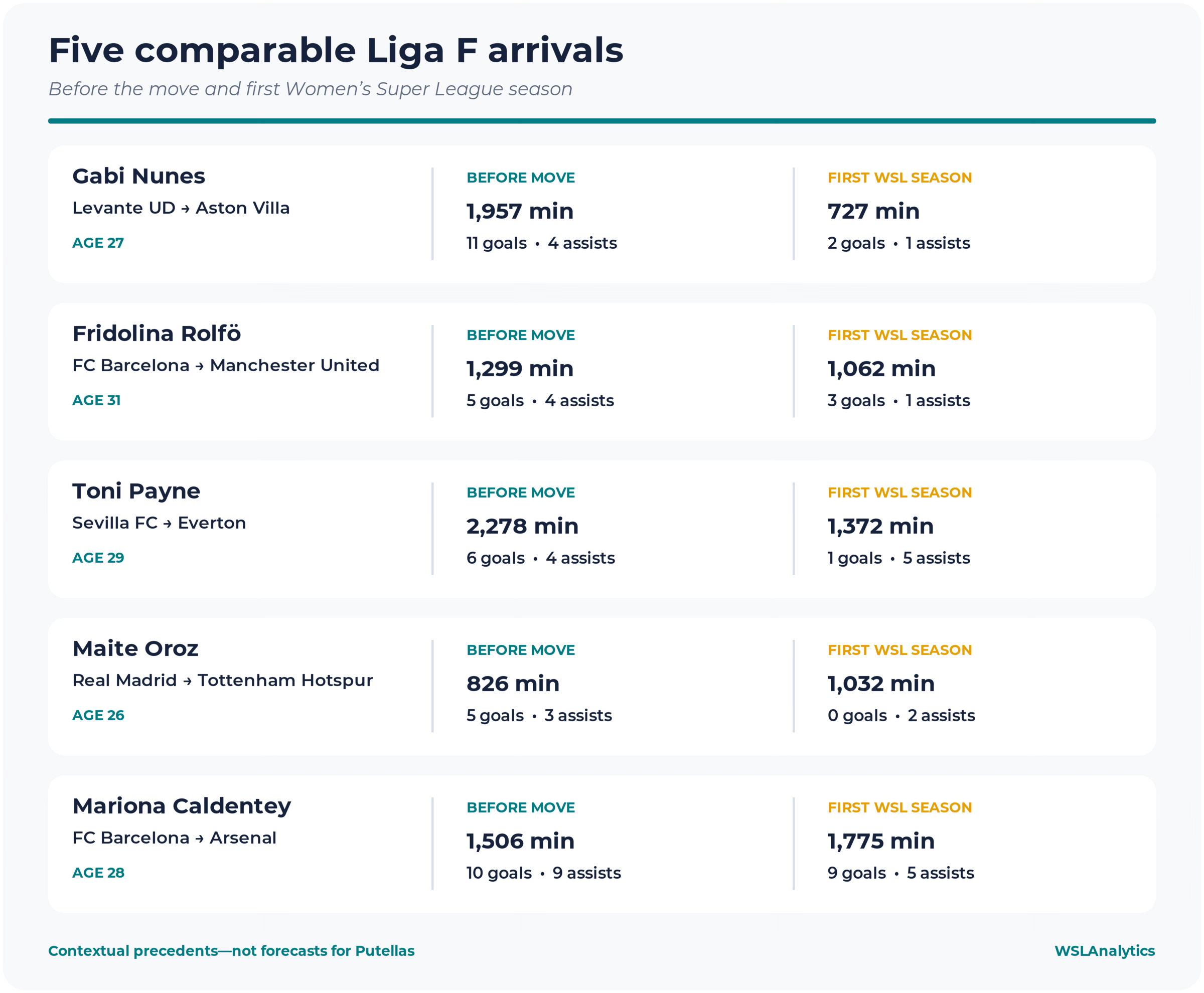
Oroz is the closest positional comparison. She moved from Real Madrid to a Tottenham side in the same broad destination-strength band, but was six years younger and arrived after substantially fewer minutes and attacking contributions.
Caldentey offers the strongest football-environment comparison. Like Putellas, she left Barcelona for England after a productive Liga F season, and her prior minutes, goals and assists were strikingly similar. The comparison breaks down because Caldentey was four years younger and joined an established top-three Arsenal side. She subsequently recorded 1,775 WSL minutes, nine goals and five assists.
Rolfö provides the closest age and club-origin precedent. She was 31 when she left Barcelona for Manchester United, but was classified as a forward and joined a club coming off a third-place finish. Her first WSL campaign brought 1,062 minutes, three goals and one assist.
Nunes and Payne are looser comparisons. Both came from Liga F and help represent different destination contexts, but both were forwards with different workloads and functions. Nunes produced 727 minutes, two goals and one assist for Aston Villa; Payne recorded 1,372 minutes, one goal and five assists for Everton.
The reasonable lesson is not that Putellas should finish somewhere between those outcomes. It is that even a relatively narrow route—Liga F to the WSL—can produce very different results. Four of the five players are classified as forwards, which also highlights the limits of broad positional comparisons. These examples provide useful context, but they do not tell us exactly what will happen next.
7. What could go wrong?
The first uncertainty is physical. Putellas is 32 and has a history of an ACL injury, a later arthroscopy on the same knee and a shorter calf injury. Her 2025–26 workload is encouraging, but previous availability cannot guarantee future availability. Sensible rotation would be management, not evidence of failure.
The second is adaptation. This will be her first senior club season outside Spain. London City cannot assume that Barcelona’s territorial control, close passing options and volume of final-third possession will follow her to England.
The third is squad balance. London City have accumulated several players who prefer central or creative roles. If Maestre cannot establish a clear hierarchy and complementary movement, Putellas could spend too much time receiving deep or facing a crowded attack.
Finally, there is the danger of asking one player to represent the entire project. London City conceded 35 league goals as well as scoring only 28. Putellas can improve their attacking connections; she cannot by herself organise the press, protect transitions and close a 22-point gap to third place.
8. Verdict
Is this a sensible transfer? Yes, with conditions.
London City have recruited a type of player they genuinely need: a central creator who can control possession, produce the final action and add goals from midfield. Her latest season offers strong evidence that the football level remains high. Her experience also fits a club trying to establish standards quickly.
The conditions are structural. She needs runners around her, protection behind her and a workload plan that respects age and injury history without treating her as a ceremonial player. London City also need to resist the idea that accumulating talent is the same as building a team.
The signing makes football sense because Putellas can improve how London City play. Whether it succeeds will depend on whether London City improve the environment in which she plays.
9. Looking ahead
Questions we’ll revisit in May 2027
Did Putellas become London City’s primary creative influence?
We will examine her playing time, goals, assists and involvement in London City’s attacking play, rather than judging her contribution through goals alone.
Did London City become a more effective attacking team?
They scored 28 league goals and recorded 487 touches in the opposition box last season. We will assess whether they improved those figures and converted their attacking possession into more consistent chances.
How well did Putellas adapt to the WSL?
We will compare her first season with the recent Liga F arrivals discussed in this article, while accounting for differences in age, role, opportunity and destination-club strength.
Was her workload managed successfully?
We will look at her minutes, starts, availability and level of production across the season. Rotation should be assessed in context rather than automatically treated as evidence of decline.
Did her arrival move London City closer to the league’s leading clubs?
Putellas cannot close the gap alone, but we will assess whether London City improved on sixth place, reduced the 22-point gap to third and became more competitive against the WSL’s strongest teams.