
Derby Weekend Didn’t Deliver — WSL Matchweek 19 Attendance Down 21% Year-on-Year
The WSL scheduled its biggest weekend of the season during the men’s international break. Three derbies, six hours, big stadiums. The attendance numbers tell a sobering story.

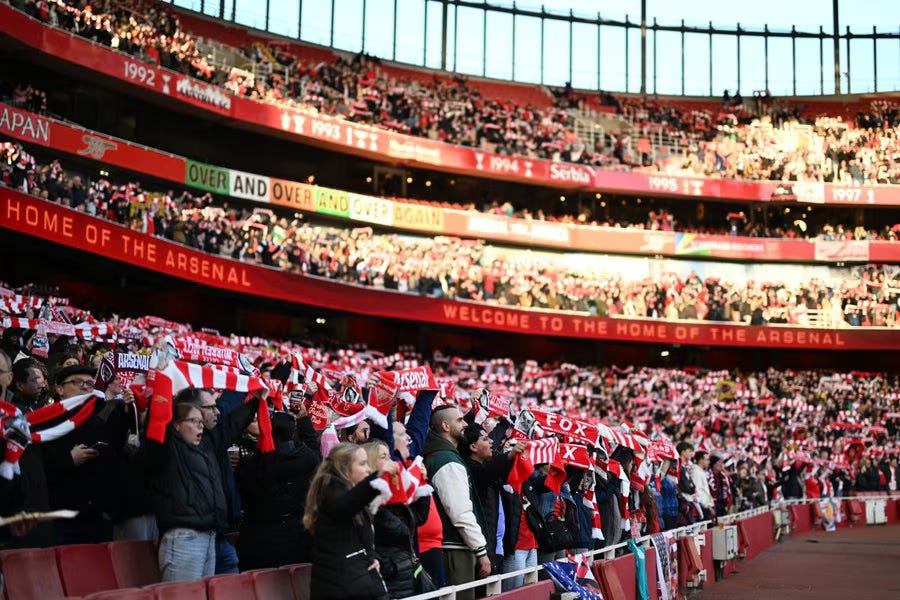
Matchweek 19 was supposed to be the centrepiece of the WSL calendar. Three top-flight derbies — Arsenal vs Tottenham, Manchester United vs Manchester City, Everton vs Liverpool — all staged on the same Saturday, deliberately timed to capitalise on the men’s international break. No Premier League competition. No scheduling clashes. Maximum visibility.
The total across all six fixtures: 83,639.
That’s not a disaster in isolation. But compared to the equivalent fixtures last season, it represents a 21% decline — and every single big-venue derby dropped.
The Numbers
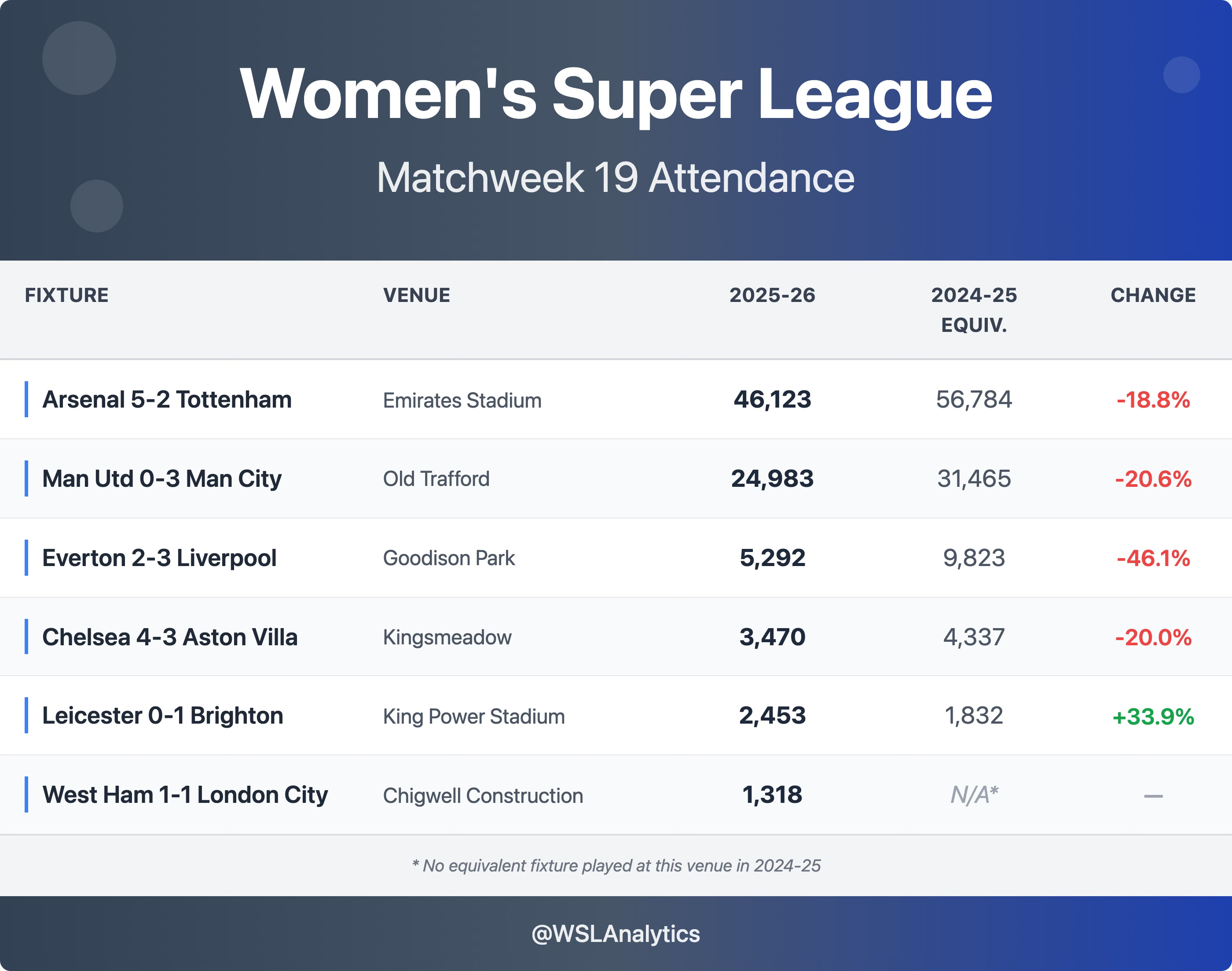
Like-for-like total (5 comparable fixtures): 82,321 vs 104,241 — down 21,920.
*London City Lionesses replaced Crystal Palace this season. For reference, West Ham vs Crystal Palace at Chigwell drew 1,292 in December 2024 — again, broadly flat.
What stands out
The North London Derby lost nearly 11,000 fans. Arsenal vs Tottenham at the Emirates drew 46,123 — a strong crowd by any measure, but down from 56,784 for the same fixture last season. That’s a drop of more than 10,600 for the WSL’s marquee rivalry, and part of a broader pattern this season.
Beyond the Chelsea match which pulled in 56,537, Arsenal’s Emirates attendances have settled into a noticeably lower range. Only two of their nine home fixtures have cleared 40,000, and the majority have drawn between 24,000 and 39,000. Arsenal remain head and shoulders above the rest of the WSL — their figures dwarf the next-best club by a factor of nearly two. The demand is still there, but the peaks are flattening.
The Merseyside derby was nearly halved. Everton vs Liverpool at Goodison drew just 5,292 — down 46% from 9,823 at Goodison in November 2024. This is the fixture that should have been the emotional centrepiece of derby weekend: Liverpool chasing their first WSL Merseyside derby win since 2019, genuine relegation stakes for the Reds, Everton’s first permanent season at Goodison. Instead, it pulled fewer fans than several non-derby fixtures earlier in the season. Scheduling it alongside the Manchester derby and the NLD — both kicking off within hours — meant the Merseyside clash ranked third in interest on its own Saturday.
Old Trafford drew 25k for a title-defining match. Man City arrived eight points clear at the top. United were fighting for Champions League qualification between the legs of their quarter-final against Bayern Munich. The 24,983 attendance was one of United’s biggest WSL crowds — but still a fifth below the 31,465 that watched the same fixture last season. For a match with that much at stake, in that venue, during a men’s break, 25k feels like it should have been higher.
The bottom end was predictable — and predictably low. Chelsea at Kingsmeadow (3,470), West Ham at Chigwell (1,318), and Leicester at the King Power (2,453) all came in within their normal seasonal ranges. These are infrastructure-constrained clubs where attendance is shaped more by venue than by fixture. The only year-on-year riser was Leicester vs Brighton — up 34%, but from a base of 1,832 to 2,453. Low-base arithmetic.
The concentration problem, again
Strip out the Emirates and the aggregate drops to 37,516 across five fixtures — an average of 7,503. Strip out Old Trafford as well and the remaining four games averaged 3,133.
This has been the defining structural pattern of the WSL’s attendance story all season. Arsenal’s Emirates fixtures account for roughly 45% of all league attendance. The next tier — Old Trafford, Stamford Bridge, Goodison, Anfield — provides occasional five-figure crowds. Everything else sits in the 1,000–4,000 band.
Derby weekend didn’t change that distribution. It reinforced it.
Did the scheduling strategy work?
The logic behind cramming derbies into the men’s international break is straightforward: with no Premier League football, the WSL owns the live schedule. Broadcasters get marquee content. Fans have no competing option. It’s the same thinking behind the September opening weekend, which has delivered strong Round 1 numbers.
But this weekend exposed the limits of that approach. Three simultaneous top-flight derbies didn’t amplify each other — they competed for attention. Media bandwidth was stretched across venues. The Merseyside derby, which in any normal weekend would have been the headline fixture, was buried. Pre-match coverage was dominated by the title implications of Man City’s trip to Old Trafford and the Russo narrative at the Emirates.
The aggregate number of ~84k is fine. But the like-for-like decline of 21% suggests the scheduling window alone isn’t enough to counteract a broader cooling trend. WSL attendances dipped roughly 10% in 2024-25 versus the prior year. This season’s equivalent fixtures are dropping again.
The wider trend
It’s worth being precise about what this does and doesn’t mean. The WSL is not in crisis. A 46,000-strong crowd at the Emirates, a near-25,000 turnout at Old Trafford, and a seven-goal thriller at Kingsmeadow are all markers of a league with genuine commercial appeal. The football itself was outstanding — Russo’s hat-trick, Miedema’s double, Holland’s derby-winning performance for Liverpool, Chelsea’s dramatic comeback.
But the attendance trajectory is no longer pointing upwards. Like-for-like fixture comparisons are declining for a second consecutive season. The gap between the top-end spectacle and the everyday WSL product remains vast.
Derby weekend was designed to be the answer to that. The numbers suggest it’s not enough.